

Future developments
Technological change in the mobility sector brings new challenges for vehicle inspections with it. This is why we are already working today on the testing technologies and tools for tomorrow.
For tomorrow’s safety
Further development of testing technologies and procedures
In order to be able to test future driver assistance systems, automated and connected driving functions and increasing electromobility in terms of safety and environmental protection, periodic vehicle inspections must continue to evolve. 90 per cent of all innovations in vehicles are now electronic, and vehicles have evolved into driving computers. We make sure that the digitalisation of testing technologies and procedures keeps pace with the digitalisation of vehicles. The current test content as part of periodic vehicle inspections (for example, electronic test procedures, wheels, chassis, lights and brakes) is therefore being expanded and optimised with a goal-oriented approach.
Automated driving
Connected mobility
Safe e-mobility
Vehicle software/cybersecurity
Dynamic test procedures
Mobility of the future
Automated driving
The increasing automation of vehicles and the growing number of driver assistance systems require technical solutions for the regular inspection of these vehicle systems. Inspecting the fitment and condition of these systems is already part of periodic technical inspections. In order to inspect function and performance efficiently, we are working with partners on test methods that incorporate static and dynamic traffic elements. These elements make it possible to test the vehicle’s reaction to a specific scenario using a suitable representation of a traffic environment.
Projects on this topic
ABSOLUT II
![]()
Project time span
10/2023 to 09/2026
Problem definition and project objective
ABSOLUT II addresses the central problem of replacing the existing on-board safety driver with a technical supervisor based in a control centre at a fixed location in compliance with the German Autonomous Driving Act (GAF) and providing the necessary technology for the control centre and for communication with the vehicle as well as the required interfaces.
Only when approved technical solutions are available to enable several autonomous vehicles to be supervised by one person will it be possible to achieve the economic viability necessary for comprehensive scaling into a wider system of automated local public transport and thus to deliver the social added value of reliable mobility, including in areas where this was previously uneconomical.
Contents
The core aspects of ABSOLUT II concern the resulting technical challenges (control centre, communication, manoeuvring interface in the vehicle), organisational questions (optimum compromise between infrastructure equipment and communication, distribution and updating of relevant data by local authority bodies, qualification requirements for technical supervisors) and legal issues (distribution of liability, licensing requirements, rights and duties).
Project partners
- Advanced Navigation Solutions – ANavS GmbH
- BitCtrl Systems GmbH
- glts cotech GmbH
- IKEM – Institute for Climate Protection, Energy and Mobility
- INIT GmbH
- Leipziger Verkehrsbetriebe (LVB) GmbH
- Sedenius Engineering GmbH
- City of Leipzig
- Dresden University of Technology (TUD)
- Associated partners: BMW Group Plant Leipzig, Leipziger Messe GmbH
The FSD’s role/contribution
- Developing evaluation metrics for automated bus shuttles based on the datasets defined in accordance with the German Autonomous Vehicle Approval and Operation Ordinance (AFGBV), including specifying and expanding the content
- Acting as a demonstrator for test procedures as part of periodic technical inspections to verify conformity under the AFGBV (for example, visualisation and validation of the event memory)
SivaS

Project time span
04/2023 to 12/2024
Problem definition and project objective
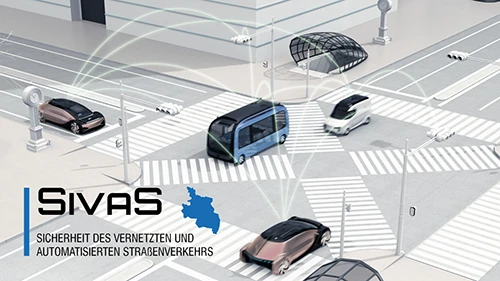
There are currently no harmonised Europe-wide specifications for assessing the safety of automated driving functions. In order to develop these necessary inspection and evaluation criteria, which the automotive industry supports, comprehensive knowledge of today’s road traffic with regard to natural driving behaviour, interactions between road users and the occurrence of critical traffic situations is required. Due to the rarity of such critical situations in real traffic, long data collection periods are necessary.
In preparation for the development of inspection and evaluation criteria, the SivaS project aims to advance the required methods and processes. In the future, they will provide the basis for specific traffic observation as a data source for the continuous further development of the criteria so that safety assessment can keep pace with the expected changes in road traffic use.
Contents
The central scope of this work involves the further development of collection and simulation methods for traffic data. This includes methods for stationary traffic observation (permanently installed camera systems, drone recordings), mobile traffic observation (naturalistic driving data) and a simulation of selected traffic situations in a driving simulator. A standardised data structure and processing chain will be created in order to transfer all data sources to a central database.
Project partners
- Dresden University of Technology
- City of Hoyerswerda
The FSD’s role/contribution
- Developing and implementing the process chain and methodology for in-vehicle data acquisition on a prototype basis
- Developing prototype specifications/assessment criteria for automated and connected driving, in particular for regular technical vehicle inspections
- Deriving a minimum dataset, in particular for regular technical vehicle inspections
- Designing sample data access to corresponding vehicle data for fully automated vehicles in accordance with Section 1g of the German Road Traffic Act (StVG) and Commission Implementing Regulation (EU) 2022/1426, in particular for regular technical vehicle inspections
ErVast

Use of dynamic traffic elements for testing automated driving functions
Funding body: Federal Ministry of Transport and Digital Infrastructure (BMVI)
Project duration: January 1, 2020 – December 31, 2021
Project partner: FSD Fahrzeugsystemdaten GmbH (consortium coordinator)
- Auto Mobil Forschung Dresden GmbH
- DEKRA Automobil GmbH
- TU Dresden – Professur für Fahrzeugmechatronik
- TU Dresden – Professur Informationstechnik für Verkehrssysteme
- HORIBA Europe GmbH
- Fraunhofer-Institut für Verkehrs- und Infrastruktursysteme IVI
- Verkehrsunfallforschung an der TU Dresden GmbH
- ZIGPOS GmbH
Project objective:
- The increase in road safety sought with the introduction of automated and connected driving functions can only be achieved through sufficient methodological testing of vehicles regarding the design, condition, function, and effect of automated and connected assistance and driving functions as part of the general inspection throughout the entire service life of the vehicle.
- The ErVast project, funded by the Federal Ministry of Transport and Digital Infrastructure, developed testing technologies and tools that can be used to efficiently conduct cross-vehicle model investigations of automated and connected assistance and driving functions.
- Vehicles currently on the road that are equipped with adaptive cruise control, lane departure warning and lane change assist systems, or automatic emergency braking functions already feature extensive sensor setups consisting of a variety of different environmental sensors based on a wide range of sensor technologies. With the introduction of fully automated vehicles, the complexity of sensor setups and driving functions continues to increase. This required the development of a cross-sensor technology test to evaluate, among other things, the correct and reliable detection of the environment.
- The testing technology developed as part of ErVast was implemented using dynamic traffic elements. This made it possible to simulate adaptive, dynamic traffic scenarios as a basis for the efficient testing of these systems during the general inspection.
- The aim of the project was to develop a method that could be used to test automated driving functions.
- The derived test procedure should be usable for semi-automated as well as highly and fully automated systems.
- The method is designed to verify reliable and accurate environment detection using dynamic traffic elements.
- The prototype implementation of the test concept took place during the project.
- The following elements were designed and developed for this purpose:
- Test vehicle with open environmental sensor interface
- Non-public test facility for testing
- Dynamic, movable traffic and infrastructure elements
- Support platform for dynamic elements
- Traffic and infrastructure elements
- Vehicle-specific test scenario
Contents:
- Development of HU-compatible test concepts for scenario-based testing of assisted and automated driving functions and associated environmental sensors during test drives
- Investigation of environmental sensors and vehicle communication
- Development of a catalog of maneuvers for deriving the necessary test scenarios
- Creation of a complete vehicle simulation to map the scenarios required for the test drive during the general inspection
- Hardware and software upgrades for test vehicles
- Testing of support systems for dynamic traffic elements
- Investigation and evaluation of a UWB-based approach to localization
- Development and implementation of a test framework to control the scenario flow and evaluate the test
- Validation of the overall approach
The role of the FSD:
Project coordinator for the ErVast project with the following responsibilities:
- Project management (project lead and coordination) and control of the project process
- Creation of a test concept for examining environmental sensors
- Development of the test concept for assistance and automated driving functions, considering the degree of automation
- Consideration of sensor and system degradation for determining evaluation thresholds
- Specification of the PTI boundary conditions for the implementation of the test concept
- Specification of test front end and target carrier
- Development of required limit values for evaluating the environment sensors based on the downstream ADAS/HAF functions
- Research communication interface and vehicle access
- Specification of test field backend regarding PTI requirements
- Development of highly dynamic target carriers and infrastructure target carriers (traffic elements)
- Draft for real test drive
- Implementation, validation, and upgrading of V2X test vehicle
- Vehicle monitoring framework module: Development of procedures (PTI integration)
- Development of interfaces between framework modules for scenario execution and vehicle monitoring as well as target/carrier/environment (connection between test vehicle and target carrier)
- Running through critical scenarios (trajectories) and evaluating the quality achieved (performing test sequence)
Safety based on communication
Connected mobility
Cooperative intelligent transport systems (C-ITS) enable different road users – such as cars and buses – and traffic infrastructure elements – such as traffic lights – to communicate seamlessly with each other and exchange traffic data in real time. Networked functions (Car2X) must be tested to ensure the safety of road users. The widespread eCall systems, for example, are already tested during periodic technical inspections. The FSD – Central Agency is developing suitable test procedures to inspect the function and performance of Car2X systems.
Sustainability on the road
Safe e-mobility
The electrification of vehicle drives together with the significant increase in the number of registered electric vehicles also calls for independent and, where possible, standardised test procedures, including for inspecting the battery and high-voltage safety of drive components to ensure safe vehicle operation. High-voltage (HV) components, in particular the high-voltage battery, are already tested for defects via the electronic vehicle interface. Visual inspections of components, cables, markings and so forth are also vitally important. The testing methods and technologies are regularly refined, with the charge/discharge efficiency, durability and, above all, the safety status of the high-voltage storage system being highly relevant.
Digitally secure
Vehicle software/cybersecurity
Software and corresponding updates, especially for safety-related systems (such as driving dynamics, driver assistance systems, engine management), must be checked for conformity and integrity in order to rule out any danger to road users or deterioration in environmental performance. Such software tests are already incorporated into (German) PTIs on an incident-specific basis due to software-related recalls. In addition, electronic software integrity checks to verify compliance with cybersecurity requirements are being established for safety-related and environmentally relevant vehicle systems produced by all manufacturers.
Dynamism in testing
Dynamic test procedures
Vehicle tests as part of PTIs and appraisals are set to become more dynamic. Such dynamic function and performance tests – for example, as part of the suspension damping test (SDT) using AI, deceleration measurement or dynamic headlight testing – will supplement the (static) electronic tests effectively and efficiently.
Current news
Charter 2030 strategy programme
The rapid development in the mobility sector towards digitalised and autonomous driving, together with connected and increasingly electrically powered fleets, brings new issues for the technical inspection of motor vehicles with it. In order to provide well-founded answers to these fundamental challenges, we have initiated the Charter 2030 Vehicle Safety programme together with the inspection institutions in Germany and published it on 3 July 2024. The initiative aims to sustainably promote both road safety and climate targets through innovative testing methods and a modernised legal framework.